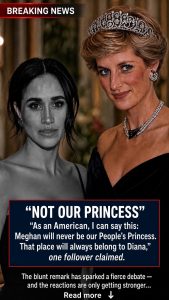
“NOT OUR PRINCESS” — A comment from one American follower has reignited a familiar debate surrounding Meghan Markle, Princess Diana and the enduring title of the “People’s Princess.” The follower claimed that Meghan could never occupy the same place in the public imagination that Diana has held for decades.
The comment reflects how powerful Diana’s legacy remains, particularly in the United States. Diana became internationally known for her warmth, charity work and emotional connection with ordinary people, qualities that helped shape the public image she carried long after her death.
The phrase “People’s Princess” became closely associated with Diana after her death in 1997, when then-Prime Minister Tony Blair famously used the expression while speaking about the extraordinary public grief surrounding her passing.
Since then, Diana’s name has remained deeply connected to the idea of a royal who could bridge the distance between the monarchy and the public. Her influence has also continued through her sons, Prince William and Prince Harry, and through the causes and memories associated with her life.
Meghan has often been compared with Diana because of her marriage to Harry and the public attention surrounding their lives. Supporters have pointed to similarities between the two women, while critics argue that Diana’s relationship with the public was unique and cannot simply be recreated.
That debate has become especially visible again following Meghan and Harry’s recent connection with Diana’s legacy. During their latest UK visit, the couple and their children visited Althorp, Diana’s childhood home and resting place.
Meghan has also continued to speak publicly about family and motherhood, while Harry has maintained a strong connection to his mother’s memory. Just recently, Harry redirected a donation connected with the Diana Fund toward an elephant conservation charity, highlighting another way he continues to honor her legacy.
For some royal followers, however, Diana’s legacy is considered something that belongs uniquely to her. The latest criticism therefore appears less about Meghan’s individual achievements and more about the belief that Diana’s emotional connection with the public cannot be replicated.
At the same time, the quoted comment represents the opinion of an individual follower rather than an established public consensus. Meghan continues to have supporters in both Britain and America, and public attitudes toward the Sussexes remain divided.
With Harry and Meghan now reportedly preparing to spend more time living in Britain with their children, scrutiny of their relationship with Diana’s legacy is unlikely to disappear. For royal watchers, the question may be less about who can replace Diana and more about why her memory still carries such extraordinary emotional power nearly three decades after her death.