Express readers pick their favourite royal – not Princess Kate
Express readers have delivered a surprising verdict on their favourite member of the Royal Family, and the result was not Princess Kate. Despite Catherine, Princess of Wales remaining one of the monarchy’s most popular and closely followed figures, another royal appears to have captured the hearts of readers through their personality, dedication and connection with the public. The unexpected choice has sparked fresh debate about what truly makes a royal beloved, with fans discussing whether hard work, authenticity, warmth or public service matters more than status and visibility. The result also highlights how quickly royal popularity can change as the monarchy enters a new generation.
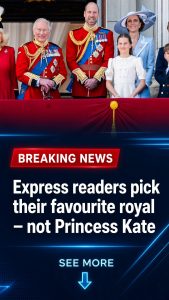
Express Readers Pick Their Favourite Royal — And It’s Not Princess Kate
A surprising royal popularity debate has captured attention after Express readers were invited to choose their favourite member of the British Royal Family, with the result reportedly challenging expectations that Catherine, Princess of Wales, would automatically take the top spot. Princess Kate remains one of the most recognizable and closely followed members of the monarchy, but the reader verdict suggested that another royal has developed an especially strong connection with the audience. The unexpected result has prompted fresh discussion about what qualities people value most in members of the Royal Family and why popularity does not always belong to the person who receives the most attention.
Princess Kate has become one of the central figures of the modern monarchy. As the wife of Prince William and the mother of Prince George, Princess Charlotte and Prince Louis, she occupies a unique position within the future of the Royal Family. Her public appearances are closely followed, her fashion choices frequently attract attention, and her charitable work has helped establish a recognizable public identity.
For those reasons, many royal watchers may have expected Kate to dominate a favourite-royal poll.
Yet the reader response produced a different result.
The outcome has encouraged fans to look beyond the obvious choices and consider why another member of the Royal Family has become so popular.
Popularity within the monarchy is not always connected to rank.
A royal does not necessarily need to be first in line to the throne to attract widespread affection.
In fact, some of the most admired members of the Royal Family have built their reputations through years of quiet service, dedication and consistency rather than through their position in the succession.
That appears to be one of the most interesting lessons from the latest reader reaction.
Different members of the Royal Family appeal to different groups of people.
Some fans are attracted to Princess Kate because of her elegance, calm public image and dedication to charitable causes.
Others admire Prince William because of his future position as King and his work on issues such as the environment and homelessness.
King Charles has supporters who appreciate his decades of public service and his long-standing interests in environmental protection, architecture, culture and education.
Queen Camilla has developed her own following through her work supporting literacy, books, reading and other charitable causes.
Princess Anne has earned enormous respect for her work ethic and remarkable record of public engagements.
And younger royals such as George, Charlotte and Louis are already attracting interest simply because of their place in the future of the monarchy.
This variety makes royal popularity difficult to predict.
A person who is not the most visible royal can still become a favourite.
Sometimes a royal’s personality creates a stronger connection than their official position.
Fans may appreciate someone who appears relaxed, humorous, hardworking or particularly comfortable when interacting with members of the public.
These qualities can make a royal seem more approachable.
That sense of connection can be extremely powerful.
Royal life is filled with ceremony, protocol and tradition, but audiences often respond most strongly to moments that appear natural.
A royal laughing with a child.
Speaking warmly to a member of the public.
Making an unexpected joke.
Showing genuine emotion during an important event.
Or simply appearing comfortable rather than overly formal.
Those moments can remain in the public memory for years.
The reader verdict has therefore opened a larger conversation about what makes a royal popular in the first place.
Is it fashion?
Is it personality?
Is it dedication?
Is it relatability?
Is it the number of public engagements?
Or is it simply the emotional connection that people develop with a particular figure over time?
There is no single answer.
Princess Kate’s popularity itself demonstrates how quickly a royal can develop a strong public image.
Since her marriage to Prince William, she has become one of the most photographed women in the world.
Her public appearances attract enormous attention, and her clothing choices can influence fashion trends.
Yet her appeal extends beyond fashion.
Her work involving children, families, early development, mental wellbeing and other charitable causes has helped establish her as a serious working member of the Royal Family.
She is also closely associated with the future of the monarchy because of her role as William’s wife.
One day, she is expected to become Queen Consort when William becomes King.
That gives her position enormous significance.
But the latest reader response shows that royal popularity is not necessarily determined by future importance.
A person can be extremely important to the institution without being everyone’s favourite.
That distinction is worth remembering when discussing polls.
A reader survey represents the opinions of those who participated.
It does not automatically represent the entire British public.
It also cannot determine the overall popularity of a royal across every age group, region or country.
Nevertheless, such polls can reveal interesting patterns.
They show which personalities generate enthusiasm among a particular audience and what qualities readers associate with their favourite royals.
The unexpected result has also generated debate among fans.
Some have expressed surprise that Princess Kate was not the clear favourite.
Others have argued that it makes perfect sense because another royal has built a reputation based on qualities that resonate strongly with people.
Supporters of the winning royal have highlighted personality, dedication and the ability to connect with ordinary people.
Critics have pointed out that popularity can change quickly depending on current events and media coverage.
Both observations are reasonable.
Royal popularity is constantly evolving.
A major public event can dramatically change how people view a royal.
A successful overseas visit can increase public admiration.
A controversial story can have the opposite effect.
A touching family moment can create a new wave of support.
A major charitable achievement can strengthen a royal’s reputation.
This makes the idea of a permanent “most popular royal” difficult to establish.
The latest result should therefore be viewed as a snapshot rather than a permanent ranking.
Still, the fact that readers selected someone other than Princess Kate is significant enough to generate discussion.
It demonstrates that the Royal Family contains a much wider range of personalities than the most frequently photographed figures.
There are royals who prefer to remain away from the spotlight.
There are royals who have spent decades working quietly.
There are royals whose public responsibilities are less glamorous but extremely demanding.
And there are royals whose personalities naturally attract attention whenever they appear.
Princess Anne is perhaps one of the clearest examples of a royal who has built respect through service.
She has developed a reputation for being direct, hardworking and highly committed to her duties.
Her style is very different from Kate’s.
Anne is not primarily known for fashion.
She does not generally seek the same level of media attention.
Instead, her reputation has been built over decades of work.
That type of consistency can create an exceptionally loyal following.
Similarly, King Charles has spent much of his life preparing for the throne.
Before becoming King, he carried out thousands of engagements and developed a wide range of charitable interests.
His supporters often point to his dedication and experience.
Queen Camilla has also gradually established her own identity within the monarchy.
Her work with books, literacy and reading has become a major part of her public role, and she has increasingly appeared alongside Charles at important events.
The younger generation offers another completely different type of royal appeal.
Prince George, Princess Charlotte and Prince Louis attract attention because people are curious about the future.
George is expected to become King.
Charlotte could eventually become an important supporting figure.
Louis is also part of the line of succession.
As they grow older, their personalities will become more visible and could eventually influence their popularity.
That makes the current reader debate particularly interesting.
The royal who is considered a favourite today may not necessarily hold that position in the future.
The monarchy itself is constantly changing.
Queen Elizabeth II’s reign created one particular relationship between the public and the Royal Family.
King Charles’s reign represents another period.
Eventually, Prince William will become King, and a new generation will take center stage.
Each generation brings different expectations.
Modern audiences are more likely to follow royal figures through social media, online video and instant news.
A royal can become popular because of a short clip that spreads online.
A single public interaction can suddenly reach millions of people.
That was far less common during previous generations.
As a result, personality has arguably become even more important.
People now see more informal moments than ever before.
They can watch royal engagements almost immediately.
They can compare public appearances.
They can discuss small details with other fans.
This creates a much more interactive relationship between the public and the monarchy.
The Express reader poll therefore fits into a much larger trend.
People are not simply interested in titles.
They are interested in personalities.
They want to know who appears genuine.
Who seems kind.
Who works hard.
Who handles pressure well.
Who interacts naturally with the public.
And who appears most comfortable with the responsibilities of royal life.
The favourite chosen by readers appears to have succeeded in connecting with that audience.
That does not mean Princess Kate has lost her popularity.
Far from it.
She remains one of the most prominent members of the Royal Family and is likely to remain a major figure for decades.
Her position alongside Prince William guarantees that she will continue to receive enormous public attention.
But popularity is not a competition with only one winner.
Different royals can be loved for different reasons.
One person may admire Kate’s elegance.
Another may admire Anne’s work ethic.
Someone else may appreciate Charles’s dedication.
Another fan may prefer Camilla’s warmth.
Younger audiences may already be developing strong attachments to Charlotte or Louis.
The diversity of those preferences is part of what makes the Royal Family so fascinating to the public.
The unexpected reader verdict therefore should not necessarily be interpreted as a rejection of Princess Kate.
Instead, it demonstrates that another royal has successfully developed a strong following.
That is a significant achievement in itself.
For the chosen favourite, the result could be seen as recognition of qualities that sometimes receive less attention than fashion or royal status.
It suggests that readers value personality and service.
It also demonstrates that quiet dedication can have a powerful effect.
A royal does not necessarily need to dominate headlines every day to become deeply respected.
Sometimes years of consistent work can create a stronger legacy than short periods of intense publicity.
This is particularly relevant to the future of the monarchy.
As the institution becomes smaller and more focused, working royals may increasingly need to demonstrate genuine commitment.
Public trust cannot be created through appearances alone.
It requires consistency.
It requires service.
And it requires members of the Royal Family to show that they understand the responsibilities associated with their positions.
The reader response may therefore reflect a broader public interest in those qualities.
The monarchy is entering a period of transition.
King Charles is establishing his reign.
Prince William is preparing for his future role.
Catherine is developing her position as the future Queen Consort.
The younger generation is growing up.
At the same time, older members of the Royal Family continue to carry out important duties.
The balance between these generations will shape the monarchy’s future.
Who becomes popular within that changing environment will depend on many factors.
Some will be connected to major events.
Some will depend on individual personalities.
Some will be influenced by the causes each royal chooses to support.
And some will simply come down to moments that capture the public imagination.
The latest Express reader verdict is therefore a fascinating reminder that royal popularity can be unpredictable.
Princess Kate may have seemed like the obvious choice to many observers, but readers demonstrated that another royal has a particularly strong place in their hearts.
That result has encouraged a fresh debate about what people actually want from the modern monarchy.
Do they prefer glamour or service?
Tradition or modernity?
Visibility or privacy?
Formal dignity or a more relaxed personality?
The answer may depend entirely on the individual.
For now, the unexpected result has created another lively chapter in the never-ending conversation surrounding Britain’s Royal Family.
Princess Kate remains one of the monarchy’s biggest stars, but the reader verdict shows that she is not alone.
Another royal has managed to win the affection of Express readers, proving once again that popularity within the Royal Family can come from many different qualities.
As the monarchy continues to evolve, these public preferences will undoubtedly continue to change.
New generations will grow up.
New royal personalities will emerge.
Older royals will leave the public stage.
And different members of the family will find new ways to connect with audiences.
For royal fans, that uncertainty is part of the fascination.
The latest result may have surprised many people, but it has also reminded everyone that the British Royal Family is made up of individuals with very different personalities, responsibilities and relationships with the public.
Princess Kate remains an important and widely admired member of that family.
But according to the latest reader verdict, another royal has captured the number-one spot among those who took part.
And that unexpected choice is likely to keep royal fans debating, comparing and discussing their favourites for some time to come.