ROYAL NEWS
TRUTH TIME
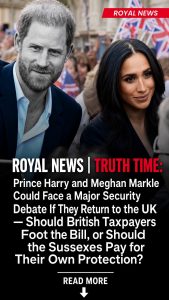
SHOULD BRITISH TAXPAYERS PAY FOR PRINCE HARRY AND MEGHAN MARKLE’S SECURITY WHEN THEY RETURN TO THE UNITED KINGDOM?
Prince Harry and Meghan Markle’s return to Britain has reignited one of the most controversial questions surrounding the Sussexes: who should pay for their security? As the couple and their children prepare to spend an extended period in the UK, questions over police protection have returned to the headlines, with the public asking whether taxpayers should once again shoulder the cost.
The issue is particularly sensitive because Harry and Meghan stepped away from their roles as working royals in 2020. After relocating to the United States, their security arrangements were changed, with protection determined on a case-by-case basis rather than automatically providing the level of police protection normally associated with senior working royals. Harry subsequently challenged the decision in court—but lost his appeal in 2025.
Now circumstances have changed. Harry and Meghan have returned to Britain with Archie and Lilibet for an extended stay, and reports indicate that the family intends to establish a longer-term presence in the country while continuing their private lives. Their return has inevitably revived questions about whether their security arrangements should also change.
The answer, however, is not simply a matter of whether Harry is royal. UK authorities assess protective security according to risk, and the Royal and VIP Executive Committee, known as RAVEC, plays a central role in determining what protection is appropriate. Recent reports say the committee is reassessing the Sussexes’ circumstances as their return becomes more permanent, but a final decision over the level and funding of protection remains unresolved.
That uncertainty has fueled a heated public debate. Some argue that Harry remains a member of the Royal Family and could face genuine security risks because of his public profile, making some level of taxpayer-funded protection reasonable. Others believe that someone who voluntarily stepped away from official royal duties and now lives as a private individual should not automatically receive the same publicly funded protection as working members of the monarchy.
The financial question is impossible to ignore. One estimate cited in recent reporting suggested that a full protection operation for the Sussexes could cost millions of pounds annually. At a time when police resources are already under pressure, critics argue that taxpayers should not be expected to finance a permanent security operation for a couple who are no longer working representatives of the Crown.
Harry’s supporters, however, point to the unusual nature of his position. He remains the son of the King and fifth in line to the throne, while his wife and children are also members of the Royal Family. Harry has argued that private security alone cannot provide the same level of protection available through the state, and court documents have recorded his previous willingness to pay personally for police protection for himself and his family.
There is also an important distinction between demanding permanent protection and receiving police protection when a specific threat exists. If authorities determine that a particular event, location or circumstance presents a serious risk, taxpayers may reasonably expect police to respond regardless of who is involved. The more controversial question is whether that should become a standing arrangement for the Sussexes simply because they are returning to Britain.
Public opinion appears far from settled. A recent poll reported by The Independent found significant support for Harry and Meghan paying for their own security needs, demonstrating that the question has become a genuine point of public debate rather than simply another royal-family dispute.
The political leadership has so far been cautious. Prime Minister Andy Burnham declined to say how the Sussexes’ security would be funded, describing the arrangements as a private matter. Ultimately, decisions about protective security are not supposed to be determined by popularity or political pressure but by the relevant authorities’ assessment of risk.
So, should British taxpayers pay? There is a strong argument that Harry and Meghan should contribute personally to their routine security as private, non-working members of the Royal Family—but there is also a legitimate case for public protection where intelligence indicates a genuine threat that only the state can safely manage. The fairest solution may therefore be neither unlimited taxpayer funding nor a complete withdrawal of police protection, but a transparent, risk-based arrangement.
For now, the final decision remains unresolved. What is certain is that Harry and Meghan’s return has reopened a debate that Britain thought it had already settled: when a royal steps away from official duties, how much public protection should come with the title—and how much should come out of their own pocket?