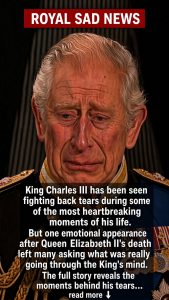
King Charles III has been seen fighting back tears during some of the most heartbreaking moments of his life. One of the clearest examples came during the final ceremonies for his mother, Queen Elizabeth II, in September 2022, when the newly crowned monarch appeared visibly emotional as he faced the reality of her death.
Queen Elizabeth II died on September 8, 2022, at Balmoral Castle after more than seven decades on the throne. For Charles, the loss was deeply personal as well as historic. Within hours, he had become King Charles III, but the weight of becoming monarch came at the same time as the loss of his mother.
In the days that followed, Charles was required to carry out a demanding schedule of constitutional and ceremonial duties while the country mourned. He met members of the public, spoke to officials and prepared for the Queen’s funeral, all while grieving in full view of the world.
During the funeral procession and service on September 19, cameras captured several moments when Charles appeared close to tears. At points, he seemed to struggle to contain his emotions as the ceremony marked the final public farewell to his mother.
One particularly emotional moment came as the congregation sang the national anthem. With the words now changed from “God Save the Queen” to “God Save the King,” Charles appeared to fight back tears. The moment carried an especially powerful symbolism: the country was saying goodbye to his mother while simultaneously beginning a new chapter under his reign.
The emotion was also evident as the Queen’s coffin made its final journey toward St George’s Chapel at Windsor. Charles and other members of the royal family walked behind it, facing the deeply personal reality that this would be their last public farewell to Elizabeth.
For Charles, the ceremony represented much more than the end of a historic reign. Elizabeth had been his mother and the person who had occupied the throne for virtually his entire life. Her death therefore marked both a profound family loss and the end of an era.
Just days earlier, Charles had delivered his first televised address as king. Speaking to the nation, he paid tribute to Elizabeth not only as monarch but as his mother, expressing his gratitude for her love, guidance and lifelong devotion to public service.
The contrast was striking. Charles had to demonstrate strength and continuity at precisely the moment when he was experiencing personal grief. His emotional appearances offered a rare glimpse behind the formal image of the monarchy and reminded the public that the new king was also a grieving son.
Even years later, those images remain among the most poignant moments of Charles’s accession. His tears were never officially explained as representing one particular thought or memory, so it is impossible to know exactly what was going through his mind. But the circumstances were unmistakable: he was saying goodbye to his mother while taking on the enormous responsibility of becoming king.