King Charles has died shock announcement accidentally hits the air
A shocking broadcast moment has left viewers stunned after an unexpected announcement claiming King Charles had died reportedly appeared on air. The sudden statement sparked confusion and widespread speculation, with audiences urgently seeking confirmation from official sources. As questions continue to surround how the announcement appeared, the incident has become a major reminder of how quickly unverified information can spread. Until officially confirmed, the claim should be treated as unverified.
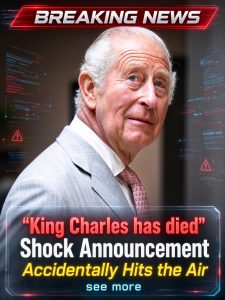
A dramatic and deeply shocking moment has reportedly unfolded after an unexpected announcement claiming that King Charles had died appeared to reach the air, immediately triggering confusion, concern, and a wave of speculation among viewers around the world.
The startling message reportedly appeared without the kind of preparation and official confirmation normally expected for news concerning the British monarch, leaving audiences questioning what had happened and whether the announcement was genuine, accidental, premature, or simply the result of a serious broadcasting error.
Almost instantly, attention turned toward Buckingham Palace and official royal communications as members of the public waited for clarification. News involving the British monarch carries enormous international significance, meaning that even a brief statement suggesting the King’s death could produce an extraordinary reaction across the United Kingdom and around the world.
Viewers who encountered the alleged announcement were reportedly left trying to understand exactly what they had witnessed. Some questioned whether a news organization had accidentally released information before it was ready, while others wondered whether a prepared graphic or emergency bulletin had been transmitted by mistake.
The unexpected nature of the message made the situation even more confusing. Major royal announcements are normally surrounded by careful preparation, official statements, and extensive coordination, so an apparently sudden announcement appearing without an accompanying explanation would naturally raise questions about its authenticity and origin.
As the claim began circulating online, social media added another layer of uncertainty. Screenshots, short clips, comments, and reposts can spread extremely quickly, sometimes reaching enormous audiences before journalists and officials have had enough time to establish whether the original information is accurate.
For many people, the first reaction to such a claim would naturally be shock. King Charles is one of the world’s most recognizable public figures, and any confirmed announcement concerning his death would have enormous constitutional, political, cultural, and historical significance. That is precisely why unverified reports surrounding such an event can create such a powerful emotional response.
The incident also raises important questions about the responsibility of broadcasters when dealing with extremely sensitive information. News organizations have systems designed to prevent premature publication of major stories, particularly reports concerning the death of senior public figures. If an announcement was genuinely transmitted accidentally, questions could arise about how the material reached the broadcast system and why it was allowed to appear publicly.
Another possibility is that viewers may have encountered a test message, rehearsal material, incorrect graphic, or other broadcast element that was never intended to represent a confirmed news report. Modern television production involves large amounts of prepared material, and mistakes can sometimes happen when multiple teams are working under intense time pressure.
Whatever the explanation, the alleged incident demonstrates how easily confusion can develop when information appears without sufficient context. A few seconds of unexpected footage can be removed from its original broadcast, uploaded online, and presented as evidence of a major event even when the circumstances surrounding it are unclear.
As the story continues to attract attention, viewers are encouraged to examine the source of any information they encounter. A screenshot or social-media post alone does not establish that a major event has occurred. Reliable confirmation should come from authoritative sources and established news organizations with a clear record of verifying major developments.
The situation also illustrates the enormous speed of modern news consumption. In previous decades, audiences might have waited for newspapers, radio bulletins, or scheduled television reports before receiving updates. Today, a single unexpected broadcast can immediately generate thousands of online discussions, allowing speculation to travel across borders within minutes.
That speed can be both useful and dangerous. It allows important information to reach the public rapidly, but it also means inaccurate information can become widespread before corrections are available. When a story concerns a major public figure, the consequences of premature reporting can be particularly significant.
For royal watchers and members of the public following the situation, patience and careful verification are therefore essential. Rather than immediately accepting the dramatic claim, audiences should wait for a formal statement and distinguish clearly between confirmed information, reports under investigation, and speculation circulating online.
The alleged broadcast has consequently become a story of its own, with attention focused not only on the claim that King Charles had died but also on how such a sensitive announcement could reportedly appear on air in the first place. The circumstances surrounding the incident may become clearer as broadcasters review what happened and as reliable sources provide further information.
It is also important to remember that dramatic headlines can sometimes be written in ways that create an impression of confirmation even when the underlying information remains uncertain. Words such as “shock,” “breaking,” and “accidentally aired” can attract enormous attention, but they do not automatically establish the truth of the claim being presented.
Until there is clear confirmation from authoritative sources, the reported death of King Charles should therefore be treated as an unverified claim. Sharing the information as confirmed fact before reliable verification could contribute to unnecessary fear, confusion, and misinformation.
The extraordinary reaction surrounding the alleged announcement serves as a powerful reminder of the influence of live broadcasting and digital media. When millions of people are watching, even a brief mistake can become an international talking point almost instantly.
For now, the central questions remain unanswered: Was the announcement accidentally transmitted? Was it a technical or editorial mistake? Was prepared material released prematurely? Or was the original claim simply misunderstood or taken out of context?
As audiences wait for credible clarification, the story continues to generate intense interest because of the unique position King Charles holds and the worldwide attention surrounding the British monarchy. Whatever ultimately caused the alleged broadcast, the incident demonstrates why sensitive breaking news must be carefully verified before it is accepted, reported, or shared as fact.
Until official information is available, viewers should remain cautious, check multiple reliable sources, and avoid treating unverified social-media posts or isolated broadcast clips as confirmation. The situation is a striking example of how quickly a single unexpected announcement can create worldwide speculation and why responsible journalism remains essential in moments involving major public figures.