King Charles III may announce this week that his planned visit to the United States will be cancelled, as rising global tensions begin to reshape the diplomatic atmosphere surrounding the British monarchy
King Charles III’s relationship with the United States came under intense scrutiny as rising global tensions created uncertainty around his planned diplomatic visit. Amid disagreements and growing international concerns, questions emerged over whether the trip should proceed and what the King’s presence in America could mean for Britain’s relationship with Washington. The situation attracted widespread attention because a royal visit carries enormous diplomatic and symbolic importance, particularly during a period of international instability. While the visit ultimately went ahead, the controversy surrounding it highlighted the delicate role King Charles must play as Britain’s monarch, maintaining political neutrality while representing the country and strengthening important international relationships.
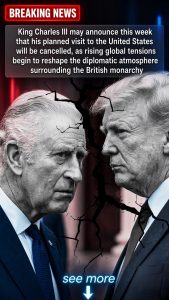
King Charles III and the U.S. Visit Controversy: How Rising Global Tensions Put the Royal Trip Under Pressure
King Charles III’s planned visit to the United States became the subject of intense international debate earlier this year as rising global tensions created an increasingly complicated diplomatic atmosphere around the British monarchy. Calls for the visit to be cancelled emerged amid the conflict involving Iran and growing disagreements between the United Kingdom and the United States. However, the situation ultimately developed differently from the cancellation scenario: the visit went ahead from April 27 to April 30, 2026, with King Charles and Queen Camilla carrying out a major state visit hosted by President Donald Trump.
The controversy surrounding the trip was significant because it placed the British monarch at the center of a sensitive diplomatic moment. A royal state visit is normally carefully planned as an opportunity to strengthen relationships between countries, celebrate shared history, and demonstrate cooperation. This particular visit, however, was being organized while tensions surrounding the Iran conflict were creating disagreements between Washington and several European governments, including Britain.
Before the visit was confirmed, there were already questions about whether it was appropriate for King Charles to travel to the United States while the international situation was becoming increasingly difficult. Some British politicians argued that the trip should be reconsidered, while others maintained that precisely because relations were under pressure, maintaining high-level diplomatic contact was more important than ever.
Public opinion also reflected the controversy. A YouGov poll published in March found that 49% of Britons opposed the King’s planned visit, compared with 33% who supported it. The figures demonstrated how divided opinion had become before the trip eventually proceeded.
The debate was not simply about the King himself.
It was about what his presence in Washington could represent.
The British monarch occupies a politically neutral constitutional position, meaning that Charles cannot behave like a political leader or openly take sides in disputes between governments. Yet a state visit by the King carries enormous symbolic importance. His presence can be interpreted as a sign of friendship, continuity, respect, and diplomatic engagement.
That created an unusually delicate situation.
If Charles travelled to Washington as planned, some critics feared that the visit could be interpreted as Britain offering support or approval at a time of serious disagreement over American foreign policy.
If the visit were cancelled, however, that decision could have sent an equally powerful message.
A cancellation by the British monarch would have attracted enormous international attention and could potentially have been interpreted as a serious diplomatic setback in the relationship between Britain and America.
The British government therefore faced a difficult calculation.
The monarchy itself does not independently determine Britain’s foreign policy. Overseas state visits by the monarch take place on government advice, meaning that decisions surrounding such trips involve the government rather than the King acting entirely on his own. Contemporary reporting during the controversy emphasized that the decision over whether the visit should proceed rested with the government.
That constitutional reality made the situation even more interesting.
Although the headlines focused on whether King Charles might cancel the visit, the decision was not simply a personal choice for the monarch.
The trip was ultimately confirmed as going ahead despite the calls for cancellation.
Buckingham Palace stated that the King and Queen would travel to the United States from April 27 to April 30, with the visit intended to recognize the historic connections and modern relationship between the two countries.
The timing was particularly important because the visit coincided with America’s 250th anniversary celebrations.
That gave the trip a broader historical purpose.
Rather than being simply another diplomatic journey, the state visit was intended to highlight centuries of connections between Britain and the United States while looking toward the future relationship between the two countries.
For Charles, it was also an important moment in his reign.
Although he had visited the United States many times before becoming King, this was his first state visit there as monarch.
That distinction mattered.
A state visit carries a different level of ceremonial and diplomatic importance from an ordinary working visit. It involves formal welcomes, meetings with national leaders, state occasions, and a carefully constructed program intended to reinforce relationships between nations.
The King therefore arrived in Washington at a moment when the stakes were unusually high.
The international situation meant that virtually every aspect of the visit could be scrutinized.
His meetings with American leaders were watched closely.
His speeches attracted attention.
His interactions with President Trump were examined for signs of warmth or tension.
Even the symbolism of the ceremonies surrounding the visit became part of the wider diplomatic conversation.
Yet Charles had an important advantage.
The monarchy has a long tradition of maintaining relationships even when political circumstances become complicated.
The King can meet leaders with whom the British government may disagree without necessarily endorsing every policy those leaders pursue.
His role is instead to represent the United Kingdom and maintain long-term relationships.
That distinction allowed Charles to carry out the visit without directly becoming a participant in the political disputes surrounding it.
The visit also demonstrated the continuing importance of the relationship between Britain and America.
Despite disagreements over specific policies, the two countries remain deeply connected through history, trade, defense, intelligence, education, culture, and countless personal relationships.
The phrase “special relationship” has been used for decades to describe those connections, although its meaning and strength have frequently been debated.
For Charles, maintaining those connections was an important part of the diplomatic purpose of the visit.
The King and Queen therefore continued with a demanding schedule rather than allowing the surrounding political tensions to dominate every aspect of the trip.
Queen Camilla also had her own program of engagements, reflecting her longstanding interests in literacy, education, culture, and social causes.
Her presence helped reinforce the idea that the visit was not solely about political leaders.
It was also about the broader relationship between British and American people.
The couple’s activities included meetings with community organizations, cultural figures, veterans, young people, and representatives of different sectors of society.
These engagements provided a softer diplomatic dimension to the visit.
A state visit is not simply about meetings behind closed doors.
It is also about creating visible connections between countries.
Royal diplomacy often operates through ceremony, culture, personal relationships, and public appearances.
Those elements can sometimes communicate messages that formal political statements cannot.
That made Charles’s visit particularly valuable during a period of uncertainty.
Rather than focusing publicly on disagreements, the King could emphasize shared history and common interests.
That does not resolve political disputes, but it can help maintain channels of communication.
The controversy before the trip also demonstrated how quickly international events can transform a royal itinerary.
State visits can take months to prepare.
Schedules must be coordinated.
Security arrangements must be organized.
Governments must agree on ceremonial details.
Officials must plan meetings and public appearances.
But none of those preparations can completely protect a diplomatic event from unexpected world events.
The Iran conflict dramatically changed the atmosphere surrounding the proposed visit.
What might have been viewed primarily as a celebration of British-American friendship became a politically sensitive event taking place during a period of international instability.
That transformation explains why calls for cancellation became so prominent.
Some critics argued that the King should not appear to lend symbolic support to an American administration involved in controversial military actions.
Others argued that cancelling the trip would have been counterproductive because the relationship between Britain and America needed communication precisely when tensions were high.
The debate therefore had two competing interpretations.
One side saw the visit as a potential diplomatic endorsement.
The other saw it as an opportunity for diplomacy.
In the end, the second approach prevailed.
Charles travelled to the United States.
The visit proceeded.
And the monarchy demonstrated that diplomatic engagement could continue even during a period of serious international disagreement.
That does not mean that all tensions disappeared.
The trip could not solve the underlying disputes between governments.
Nor could the King personally determine American or British foreign policy.
But his presence offered an opportunity to reinforce relationships that extend beyond any single political disagreement.
That may ultimately have been the most important message of the visit.
The relationship between Britain and America is much larger than one government or one president.
It includes generations of cooperation and shared institutions.
It includes military alliances and economic partnerships.
It includes families with connections across the Atlantic.
It includes universities, businesses, charities, cultural organizations, and millions of ordinary people.
A royal state visit can therefore emphasize continuity even when political relationships are under strain.
For Charles, this was especially important because his reign is still relatively young compared with the decades-long reign of his late mother, Queen Elizabeth II.
Every major international visit helps establish his identity as monarch.
His American state visit was therefore not only a diplomatic event but also an important moment in his reign.
The King had to demonstrate the ability to maintain Britain’s international relationships while respecting the political neutrality of the Crown.
He also had to operate under intense scrutiny.
Every photograph could become a headline.
Every conversation could be analyzed.
Every public gesture could be interpreted as a diplomatic signal.
Yet Charles appeared to maintain the approach expected of a constitutional monarch.
He represented Britain without becoming a political participant in the disputes surrounding the visit.
That was perhaps one of the greatest tests of the trip.
The circumstances also highlighted the unusual nature of royal diplomacy.
An elected political leader can openly negotiate, criticize, threaten, compromise, or announce policy.
A monarch operates differently.
Charles’s influence comes largely from symbolism, continuity, personal relationships, and the ability to bring people together.
That can make royal diplomacy particularly valuable during periods when governments disagree.
The King can emphasize common ground without directly negotiating political policy.
He can maintain relationships without taking sides.
He can represent the British people while allowing elected officials to conduct formal foreign policy.
The U.S. visit provided a clear example of that distinction.
There was also an important security dimension to the trip.
The visit took place shortly after a serious security incident in Washington involving an attempted entry by a gunman at a dinner attended by President Trump. Security arrangements surrounding the royal visit were subsequently reassessed, although officials did not publicly disclose detailed measures.
That added another layer of complexity.
The King and Queen were travelling to a country experiencing heightened political and security tensions, while the international environment was already unstable.
Nevertheless, the visit continued.
Their itinerary took them beyond Washington, including engagements in New York and Virginia, allowing the couple to highlight different aspects of the British-American relationship.
The final result was therefore very different from the earlier speculation.
Rather than announcing a cancellation, King Charles completed the state visit.
The trip became an example of diplomacy continuing despite serious disagreement.
For royal watchers, the episode also provided an important lesson about how carefully the monarchy operates.
Headlines suggesting that the King might personally decide to cancel an international visit can oversimplify the constitutional reality.
The British monarch acts on government advice in matters of this nature.
The government has to consider the diplomatic consequences, while the Palace has to manage the King’s role and public responsibilities.
That relationship between the government and the monarchy becomes particularly important when international circumstances become complicated.
The controversy surrounding the U.S. trip demonstrated exactly why.
The government needed to decide whether the diplomatic benefits of the visit outweighed the political risks.
The Palace needed to prepare the King and Queen for a visit that could attract intense scrutiny.
And the wider public had to decide whether they believed the trip was appropriate.
The result was a visit that went ahead despite substantial opposition.
That decision will likely continue to be discussed because it occurred during such an unusual period.
It also demonstrated how closely the monarchy remains connected to Britain’s international identity.
Even though the King does not make foreign policy, his international movements can still carry significant symbolic meaning.
A handshake between Charles and a foreign leader can become an image representing an entire bilateral relationship.
A state banquet can become a demonstration of friendship.
A speech can emphasize shared history.
A visit to a community can highlight cultural connections.
Those symbolic moments can matter greatly in diplomacy.
For Charles, the U.S. visit therefore represented a complicated but important test.
He had to navigate political sensitivity without becoming political.
He had to demonstrate friendship without appearing to endorse every policy of the American government.
He had to represent Britain’s interests while remaining within the constitutional boundaries of the Crown.
And he had to do all of this while the international environment was changing rapidly around him.
The fact that the visit ultimately proceeded suggests that the British government considered maintaining the relationship with Washington important enough to continue despite the surrounding controversy.
The visit also showed that diplomacy does not necessarily stop when governments disagree.
Sometimes, difficult circumstances make communication more important.
The monarchy’s role in such moments is not to solve conflicts but to preserve relationships and provide continuity.
That may be the most important lesson from the controversy surrounding Charles’s U.S. trip.
The original claim that the King might announce a cancellation reflected genuine political debate that took place before the visit.
There were real calls for the trip to be reconsidered, and public opinion was divided.
But those calls did not ultimately result in cancellation.
The King and Queen travelled to the United States, completed their state visit, and returned to Britain.
The episode nevertheless remains significant because it illustrates how quickly a royal event can become intertwined with global politics.
A planned ceremonial visit can suddenly become a diplomatic test.
A royal appearance can become a political symbol.
And a decision about whether a monarch should travel can become the subject of national debate.
King Charles’s U.S. visit ultimately went ahead, but the controversy surrounding it demonstrated that future royal diplomacy will continue to be shaped by the rapidly changing international environment.
As global tensions rise and relationships between major powers become more complicated, the monarchy will increasingly face moments when its traditional role of neutrality, continuity, and diplomacy is tested.
For Charles, the challenge will be maintaining those principles while representing Britain on the world stage.
The U.S. visit showed that this balancing act is not always easy.
But it also showed that even during periods of serious disagreement, diplomacy can continue.
And for the British monarchy, that may be one of its most important roles in an increasingly uncertain world.