Odd reason Prince George’s time at Eton will be totally different to William’s
Prince George’s potential time at Eton could be dramatically different from the experience his father, Prince William, had decades ago. While both father and son would share the unique experience of attending one of Britain’s most famous schools as future Kings, George is growing up in a completely different world shaped by smartphones, social media and instant global attention. His every move is likely to attract intense interest, while his parents will face the challenge of protecting his privacy and giving him as normal a school experience as possible. As George prepares for his future role, his education could become an important part of learning how to balance royal duty, personal freedom, friendships and the enormous expectations surrounding the future monarch.
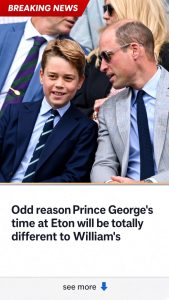
Odd Reason Prince George’s Time at Eton Will Be Totally Different to William’s
Prince George’s potential future at Eton is already attracting considerable attention, with royal watchers suggesting that his experience at the famous school could be very different from the one his father, Prince William, had decades earlier. Although both father and son are expected to share the unusual experience of growing up under intense royal scrutiny, George would enter Eton in a completely different era, with a very different media environment, a different family structure and an entirely new set of expectations surrounding the future King.
Prince William attended Eton College after leaving Ludgrove School, beginning his time there in the early 1990s. His years at the school were closely watched because he was second in line to the throne and already one of the most recognizable young people in Britain. However, the world George is growing up in is dramatically different from the one his father knew.
One of the biggest differences is the sheer speed at which information travels today.
When William attended Eton, social media did not exist. There were no smartphones capable of instantly recording every moment, no viral videos appearing within seconds and no online platforms where millions of people could debate a teenager’s every appearance.
George will face a very different environment.
By the time he begins his own secondary education, interest in him is likely to be enormous. He is not simply a young member of the Royal Family. He is the future King, meaning that every major stage of his childhood and education is likely to attract attention.
That creates a particularly unusual situation.
Eton is a prestigious school with its own traditions, culture and expectations, but George’s presence could bring an extraordinary level of public interest.
His classmates will know that he is destined for an important constitutional role.
Teachers will understand the unique circumstances surrounding his education.
And the wider public will inevitably be curious about how the future monarch adapts to school life.
Yet his parents are likely to want him to experience as normal an education as possible.
Prince William and Catherine, Princess of Wales, have repeatedly emphasized the importance of giving their children a grounded upbringing despite their extraordinary position.
That could mean George’s experience at Eton is carefully protected from unnecessary publicity.
Security arrangements would almost certainly be different from those surrounding ordinary pupils, but much of his daily school life could remain private.
This is where his experience could differ significantly from William’s.
William was already famous, but the digital world was still in its infancy.
George will enter adulthood in an age when almost every significant public moment can be recorded, shared and discussed worldwide.
A photograph taken casually by another student could potentially spread far beyond the school community.
A short video could become a global news story.
A seemingly ordinary interaction could generate speculation about his personality, friendships or future.
That level of exposure did not exist in the same way when William was a teenager.
There is another major difference.
George is growing up with two younger siblings, Princess Charlotte and Prince Louis, who are likely to play important roles in his life as he prepares for the responsibilities of the Crown.
William also had a younger brother, Prince Harry, but the circumstances surrounding their childhood and their eventual adult relationship have been very different.
George and Charlotte in particular have already attracted attention because of the possibility that Charlotte could become an important source of support for her older brother.
This could create a family dynamic that resembles the relationship between King Charles and Princess Anne.
The comparison should not be treated as a prediction, but it highlights how important siblings can become to a future monarch.
George may eventually depend heavily on Charlotte and Louis as trusted members of his family.
His education could therefore be part of a much larger preparation for the future.
Eton would not simply be about academic subjects.
For George, education would also involve learning how to manage responsibility, relationships, public expectations and personal privacy.
The school environment could give him an opportunity to interact with people outside the immediate royal circle.
That could be extremely valuable.
A future King needs to understand the experiences of people from many different backgrounds.
Although George’s life will inevitably be unusual, education can provide opportunities to develop friendships and perspectives that extend beyond palace life.
This is another reason why the choice of school matters so much.
Eton has a long association with Britain’s political, cultural and royal history.
William attended the school.
Prince Harry attended Eton as well.
Other prominent figures have also studied there.
George’s potential attendance would therefore continue a family tradition while simultaneously creating a new chapter.
But George would not simply be repeating his father’s experience.
The monarchy itself has changed.
When William was a student, Queen Elizabeth II was monarch.
Today, his father is King Charles III.
By the time George attends Eton, the monarchy could be moving through another stage of transition.
That means George’s education could take place against a completely different royal backdrop.
William’s childhood was shaped by the long reign of his grandmother and by his parents’ highly publicized marriage.
George’s childhood is being shaped by his father’s preparation to become King and his mother’s growing role as one of the most important members of the future monarchy.
The expectations surrounding George are therefore enormous.
He is being raised to understand that one day he will inherit the Crown.
Yet his parents also have to ensure that he does not feel defined entirely by that future.
That balance could be one of the greatest challenges of his education.
George needs to understand duty without losing his sense of individuality.
He needs to prepare for public life while still being allowed to experience ordinary childhood moments.
And he needs to develop relationships that are based on trust rather than simply on his position.
Eton could provide an environment where some of those lessons take place naturally.
The school would expose him to academic competition, teamwork, leadership and friendships.
He would also have to navigate the ordinary pressures experienced by other students.
Exams.
Deadlines.
Sports.
Friendships.
School traditions.
And the transition from childhood toward adulthood.
Of course, George’s circumstances would never be completely ordinary.
Security considerations would always be present.
His identity would be known.
And his future position would inevitably influence how people perceive him.
But the hope would likely be that he can experience as much normality as his circumstances allow.
This could also explain why his time at Eton may be “totally different” from William’s.
The biggest difference may not be the school itself.
It may be the world surrounding the school.
The internet has transformed the relationship between public figures and the public.
William’s teenage years were documented by newspapers and photographers.
George’s teenage years could be documented by an entire digital ecosystem.
That means the Royal Family will have to think carefully about privacy.
The Wales family has already become increasingly aware of the challenges created by online speculation.
Protecting their children’s private lives has become an important consideration.
George’s parents will therefore have to balance public interest with his right to grow up away from constant attention.
The situation could become particularly complicated as George gets older.
At some point, he will begin making his own decisions.
He will have his own interests.
He will form his own friendships.
He will develop his own opinions.
And he will eventually become more responsible for his own public image.
His time at Eton could therefore be an important stage in that development.
William’s experience could provide useful lessons.
His parents’ experiences could provide others.
And the Royal Family’s approach to George’s education will likely be shaped by everything that has happened over previous generations.
There is also a fascinating contrast between William’s experience and the childhood of King Charles.
Charles attended Gordonstoun, a very different school environment, while William and Harry went to Eton.
The Royal Family has therefore never followed one single educational path.
Each generation has experienced different expectations and challenges.
George’s eventual education will be another example of how the monarchy adapts.
The choice of Eton, if confirmed, could also carry symbolic significance.
It would connect George with his father and uncle while placing him within an institution with a long history of educating Britain’s future leaders.
But George’s generation is facing challenges that William’s generation could not have anticipated.
Artificial intelligence, social media, misinformation, cyberbullying and constant digital surveillance are now part of everyday life.
A future King will need to understand not only traditional politics and history but also how information moves through modern society.
He will eventually need to communicate with people who receive news through completely different channels.
That could make his education particularly important.
George will also grow up in a monarchy that has become more focused on a smaller number of working members.
As the Royal Family becomes more streamlined, every future working royal could carry greater responsibility.
George will eventually be at the center of that structure.
Charlotte and Louis may also have important supporting roles.
This could make the relationships between the siblings extremely important.
William understands the pressure of being the future King because he has lived with it since childhood.
He may therefore be particularly determined to ensure that George is prepared without being overwhelmed.
The experience of watching his own mother, Princess Diana, deal with intense media attention could also influence how William approaches his children’s upbringing.
The world George enters will be different, but the lessons from previous generations remain relevant.
His parents will likely want him to understand that being King is not simply about privilege.
It is about responsibility.
It involves public service, diplomacy, constitutional obligations and the ability to represent millions of people.
Eton could help develop some of the skills necessary for that future.
But perhaps the most important part of George’s education will happen outside the classroom.
He will learn how to deal with pressure.
He will learn how to make friends.
He will learn how to handle criticism.
He will learn how to make mistakes.
And eventually, he will learn how to lead.
That is why his time at Eton could become one of the most closely watched stages of his young life.
Yet the public should also remember that George is still a young person.
Speculation about his future can easily become excessive.
He should not be judged as though he is already King.
His personality is still developing.
His interests may change.
His future plans may evolve.
And the monarchy itself could look very different by the time he inherits the throne.
The idea that his Eton years will be “totally different” from William’s therefore goes beyond the question of school.
It is about two generations growing up in completely different worlds.
William was raised during an era of newspapers, television and traditional celebrity culture.
George is growing up during the era of smartphones, social media and instant global communication.
William experienced the enormous public attention surrounding Princess Diana.
George is growing up with the legacy of that history while being raised by parents who have learned from it.
William entered adulthood as a young royal who had already experienced extraordinary public scrutiny.
George may experience even greater scrutiny from a much younger age.
That could make privacy one of the most valuable things his parents can give him.
If George eventually attends Eton, his time there will undoubtedly be watched with enormous interest.
But the most important story may not be what uniform he wears, which subjects he studies or which activities he joins.
It may be how he develops as a person.
Will he become confident?
Will he be reserved?
Will he enjoy sports?
Will he develop a passion for history, science, art or another subject?
Will he form lifelong friendships?
Will he resemble William or develop a personality completely different from his father?
Nobody can know yet.
And perhaps that uncertainty is exactly what makes his future so fascinating.
George’s education will eventually become part of the story of a future King.
But before that happens, he has the opportunity to simply be a student.
That is likely to be one of the greatest differences between the public image of George and the reality of his childhood.
Behind the headlines and royal speculation is a young boy who still has years before he assumes any constitutional responsibility.
His parents will likely want to protect that time as much as possible.
When the day eventually comes for George to enter Eton, it could represent a major milestone.
It would connect him to his father’s past while simultaneously beginning a completely new chapter.
William’s Eton years belong to another era.
George’s will belong to a monarchy shaped by a digital world, a changing society and a new generation.
The school may be the same, but the circumstances surrounding it will be remarkably different.
And that may be the real reason Prince George’s time at Eton could be unlike anything his father experienced.