Prince William & Prince Henry weren’t even allowed to cry for their mother, ‘Princess Diana,’ at her funeral
A heartbreaking look back at Princess Diana’s funeral, when young Prince William and Prince Harry faced unimaginable grief in front of the entire world. Their emotional struggle, the pressure to remain composed, and Harry’s later revelations offer a deeper look at one of the most painful moments in royal history.
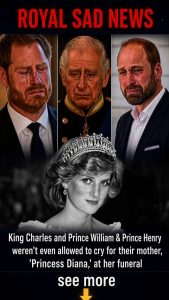
The funeral of Princess Diana on September 6, 1997, became one of the most emotional and closely watched moments in modern royal history. Her sons, Prince William and Prince Harry, were only 15 and 12 years old when they walked behind their mother’s coffin through London toward Westminster Abbey. Millions of people watched the procession, but behind the solemn expressions were two young boys trying to cope with the devastating loss of their mother. The decision to have them participate in the procession has remained controversial for decades, particularly because of their young ages and the enormous public pressure surrounding the funeral. (Wikipedia)
The popular claim that William and Harry were “not allowed to cry” at their mother’s funeral needs some important context. There is no solid evidence that King Charles formally ordered his sons not to cry. However, Prince Harry later described how he struggled to express his grief publicly and how the culture of emotional restraint surrounding the Royal Family affected him. In his memoir Spare, Harry recalled that he did not cry during the public funeral procession and said that he eventually broke down only after his mother had been buried at Althorp. His account has helped explain why the image of the seemingly composed young prince may have hidden an enormous amount of private pain.
For Harry, the most painful part of the day was not necessarily the procession itself but the expectation that he should continue moving forward despite losing his mother. He was just 12 years old, yet he was surrounded by cameras and millions of mourners as he walked behind the coffin. In Spare, Harry recalled nearly crying during the funeral service, but he held his emotions back. Later, when Diana’s coffin was lowered at her burial place, he finally allowed himself to cry uncontrollably. He described feeling ashamed afterward, reflecting how strongly he had internalized the idea that he was supposed to remain emotionally controlled.
Prince William faced the same extraordinary circumstances, although his later reflections have often emphasized duty and family. At 15, he was old enough to understand much of what was happening but still a child dealing with the sudden death of his mother. William has described walking behind Diana’s coffin as one of the hardest experiences of his life. The two brothers were joined by their father, then Prince Charles, their grandfather Prince Philip and Diana’s brother, Earl Spencer. The presence of their grandfather was particularly significant because Philip offered to walk alongside the boys, giving them reassurance during an experience that many people believe no child should have had to endure.
There had been serious discussion within the family about whether William and Harry should participate in the procession at all. Later accounts indicate that Prince Philip was initially opposed to the idea of the boys walking behind the coffin, reportedly questioning why they were being treated as part of a ceremonial arrangement when they had just lost their mother. Harry later wrote that several adults were horrified by the prospect and that there were even suggestions that William might walk without him. Harry said he did not want his brother to face the experience alone and believed that William would have done the same for him if their positions had been reversed.
The image of Prince Charles walking behind Diana’s coffin alongside his sons has also remained deeply significant. At the time, Charles was not yet King Charles III; he was Diana’s former husband and the father of the two grieving boys. Accounts of the period show that the wider royal family was attempting to protect William and Harry from the enormous media attention surrounding Diana’s death. The boys spent time at Balmoral following her death before returning to London, while the public mourned outside Kensington Palace and elsewhere. Former royal press secretary Dickie Arbiter later argued that the family’s decision to remain with the boys was intended to give them privacy and support rather than to ignore the public’s grief.
Nearly three decades later, the funeral continues to generate debate because of what the photographs cannot show. The world could see William and Harry walking behind the coffin, but it could not see everything happening inside their minds. Harry’s later account suggests that he experienced intense grief while trying to maintain control in front of the cameras. William has similarly spoken about the extraordinary difficulty of the experience. Their silence should therefore not automatically be interpreted as a lack of emotion. For two young brothers, remaining composed may simply have been the only way they knew how to get through one of the most painful days of their lives.
Today, the funeral of Princess Diana remains a defining memory of William and Harry’s childhood. The dramatic headline that they were “not even allowed to cry” captures the emotional power of the story, but the historical record is more complicated: there is no established evidence of a formal ban on crying. What is clear is that the brothers were placed under extraordinary pressure to perform a public duty while mourning their mother. Harry’s later revelations have brought renewed attention to the private grief behind those famous images, while William’s reflections show that he too understood the immense weight of that day. More than anything, the procession remains a haunting reminder that behind the royal titles were two children saying goodbye to their mother before the eyes of the world.