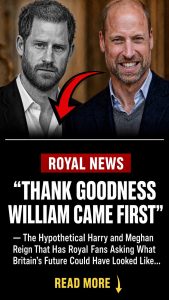
THANK GOODNESS PRINCE WILLIAM CAME FIRST
CAN YOU IMAGINE HARRY AND MEGHAN AS KING AND QUEEN?
For many royal watchers, the line of succession is more than a constitutional arrangement—it is the reason Britain has Prince William, rather than Prince Harry, positioned to become the next monarch. With William firmly established as heir to the throne, an intriguing question continues to capture the imagination of royal observers: what would the monarchy look like if Harry and Meghan had ever found themselves at its center?
The thought may seem impossible today, but Harry was once much closer to the throne. As the younger son of King Charles III and Princess Diana, he spent much of his childhood knowing that royal life could eventually place enormous responsibilities on his shoulders. His position changed dramatically when William became the future King and Harry increasingly developed a separate identity within the Royal Family.
William’s path has been fundamentally different. He has spent decades preparing for the responsibilities of monarchy, carrying out official engagements, supporting national causes and gradually assuming a larger role beside his father. Alongside Catherine, Princess of Wales, he has also become one of the most recognizable faces of the modern monarchy.
Harry and Meghan, meanwhile, chose a very different direction. In 2020, they stepped back from their roles as working members of the Royal Family and eventually established their primary home in California. Their decision transformed their relationship with the institution and created one of the most dramatic chapters in modern royal history.
That history makes the hypothetical scenario of “King Harry and Queen Meghan” particularly fascinating. Would they have approached the Crown differently? Would Harry have embraced a more traditional model of monarchy, or would Meghan have encouraged a dramatically more modern approach? There is no way to know, but the contrast between the Sussexes’ current life and William’s preparation for kingship makes the question especially compelling.
The monarchy has always evolved with the times, but the transition from one sovereign to another is expected to preserve a degree of continuity. William has spent years learning how that system works from his grandmother, Queen Elizabeth II, his father, King Charles, and generations of royal tradition. His eventual reign is therefore expected to represent both continuity and change.
Harry’s experience has been almost the opposite. He has repeatedly spoken about wanting greater freedom from the restrictions of royal life, while Meghan has built a public identity largely outside the traditional royal system. Their decision to step away demonstrated just how difficult the demands of royal life could become when personal independence and institutional expectations collide.
There is also the question of public perception. William and Catherine have gradually developed their own relationship with the British public, while Harry and Meghan have become highly polarizing figures. Supporters view the Sussexes as a couple who challenged an outdated institution and sought greater control over their lives. Critics argue that they benefited from their royal connections while publicly criticizing the institution they left.
If Harry had somehow become King, those unresolved questions could have become constitutional and national issues rather than simply family disputes. Every personal decision would have carried greater consequences, and every disagreement involving Meghan, William or other members of the Royal Family would have attracted enormous scrutiny.
But the reality is much simpler. William is the heir, and Harry is not. The British monarchy’s future is currently centered on William and his children, with Prince George next in line after his father, followed by Princess Charlotte and Prince Louis. Harry’s role remains that of a non-working member of the Royal Family living primarily outside the institutional center of the monarchy.
So perhaps the question is less about imagining “King Harry and Queen Meghan” and more about understanding how dramatically different their lives became from the path once expected of them. One brother prepared for the Crown; the other chose a new life beyond it.
And that contrast is exactly why the phrase “Thank goodness William came first” continues to provoke such strong reactions among royal watchers. Whether one agrees with that sentiment or not, there is no denying that the order of succession shaped two completely different futures—and ensured that the question of Harry and Meghan ruling Britain remains firmly in the realm of imagination.